
Sending an order involves much more than just shipping a box—it means ensuring that the product arrives safely, on time, and without any unexpected issues.
We know that every shipment carries significant expectations, whether from an end customer or an operational team. That’s why we’ve compiled some essential packaging best practices below to help prevent damage, delays, and even shipping hold-ups.
GENERAL TIPS
These guidelines apply to all shipments, regardless of the carrier:
Choosing Packaging
-
Use new, sturdy boxes that are suitable for the product’s weight and size.
-
Avoid reusing damaged or dented boxes.
-
Opt for double-wall cardboard boxes for heavier items.
Internal Protection
-
Fill all empty spaces with:
-
Bubble wrap.
-
Kraft paper.
-
Foam or cushioning material.
-
-
The product must not move around inside the box!.
Proper Size
-
Avoid using boxes that are too large for small items.
-
Oversized packaging increases the risk of damage and additional costs.
Proper Sealing
-
Use wide, sturdy packing tape.
-
Apply the tape in an “H” shape (top, bottom, and corners of the box).
-
Do not use flimsy or makeshift tape.
-
Do not tie the box shut with any type of string or rope.
Shipment Identification
-
Ensure that the label is:
-
Securely attached.
-
Visible.
-
Free of creases or erasures on the AWB paper/label.
-
-
Avoid covering barcodes with tape.
-
Using a label printer can greatly streamline the process.
-
If you do not have a label printer, request the “small bags” at the time of pickup so you can place the documents in your shipment and ship it safely.
Protection Against External Factors
-
For sensitive items, use protection against:
-
Moisture.
-
Dust.
-
Temperature fluctuations.
-
Fragile Items
-
Label them with tags such as “Fragile” (when applicable).
-
Reinforce the internal padding.
-
Consider double-boxing (one box inside another).
TIPS BY CARRIER:
Each carrier has its own operational requirements. Following these recommendations can help prevent problems during shipping.
DHL
-
Avoid irregularly shaped packages (cylindrical or loose items).
-
Reinforce lightweight boxes securely—DHL uses automated sorting.
-
Documents must be placed in an outer plastic envelope (when necessary).
-
For international shipments, ensure that the packaging can withstand long transit times.
UPS
-
Use packaging that can withstand stacking.
-
Avoid overloading small boxes.
-
Make sure the label is properly positioned (on the top).
-
Do not use external string or rope.
FedEx
-
Use sturdy, well-sealed boxes.
-
Avoid uneven surfaces that make it difficult to read the label.
-
For fragile items, use reinforced internal padding.
-
Make sure the packaging is suitable for international shipping.
QUICK CHECKLIST
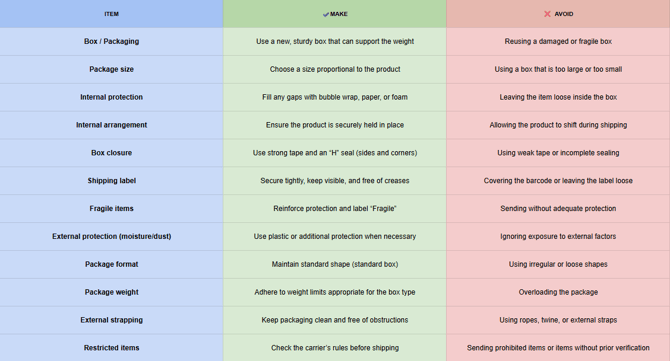
REMEMBER
Good packaging isn’t just about protection—it’s part of the customer experience.
-
When done right, it:
-
Reduces operational risks.
-
Prevents delays.
-
Improves the delivery experience.
-
🚨 SHIPPING RESTRICTIONS
Always check the carrier’s rules before shipping.
Restricted or prohibited items may:
-
Result in the shipment being returned.
-
Cause customs delays.
-
Lead to the disposal of the goods.
-
Result in a permanent ban on shipping any new shipments with that carrier.
If you need to check which items are restricted for shipping before packing your box, simply visit our Help Center on the ShipSmart website:
- Shipment Management
-
-
Shipping Restrictions Carriers
-
Or you can click the link:
READ THE ARTICLE ON RESTRICTIONS BY CLICKING HERE.
If you have any questions, our Team is here to assist you in any way we can 💙